


Showing 1 - 20 of 155 results:
Problem Set
One of the advantages of a window assembly that uses an inert gas in the air gap is: (a)Inert gases are not explosive. (b)The inert gas acts as an insulator and reduces the heat transfer through the window. (c)These windows can use single pane glazing. (d)Windows with inert gases are low cost.
Problem Set
Core systems A. Use a central plumbing core, where plumbing areas are placed in close proximity to the water heater. B. Pipe hot water directly to each fixture or group of fixtures using smaller diameter piping when appropriate and as direct a path as possible. C. Are more expensive and take longer...
Problem Set
Manifold Plumbing Systems A. Uses larger, inflexible piping. B. Are also called parallel pipe or home run systems C. Use small diameter, flexible piping (such as PEX) that run directly to each individual fixture from a central manifold. D. Use of flexible piping allows these systems to be installed...
Problem Set
Trunk and branch systems A. Are the most common type of hot water delivery system. B. Are most suitable for larger homes in terms of maximizing hot water delivery system efficiency. C. Are characterized by one long, large diameter main line (i.e., the “trunk”) that runs from the water heater to the...
Lecture Notes
These lecture notes provide information about the improtance of system design and a balanced system.
Lecture Notes
These lecture notes provide information about the basic principles of heat transfer in buildings.
Problem Set
The “Four Ds”of controlling moisture and fungal growth resulting from moisture are: Deflection, drainage, drying, and durable components Diffusion, drainage, drying, and durable components Diffusion, deflection, drainage, and drying Deflection, diffusion, drainage, and durable components
Lecture Notes
These lecture notes provide information about how to control moisture in buildings.
Problem Set
Air sealing can unintentionally make the air inside a building: 1. Better 2. Worse
Teaching Material
The Impact of Buildings Using Energy
Teaching Material
In this video, the fundamental concepts of power and energy are described to provide a baseline understanding of these two important terms. Discussion includes dimensions, units, and example calculations associated with power and energy.
Teaching Material
Video that details and explains Building and Energy Codes.
Problem Set
Identify and explain the role of 3 building-related stakeholders that are affected in a natural disaster.
Lecture Notes
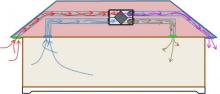
Understanding the customer benefits and how they should be communicated to the customer in order to increase the sale of air-source heap pumps. Additionally, information on current market trends and how they indicate the rise in interest of heat pumps. And how to make a business case for air sourced...
Teaching Material
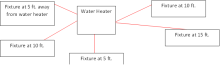
This image represents a plumbing layout that can be used to help determine if WaterSense criteria is met.
Problem Set
For the plumbing layout below, assuming all pipes are copper M and 3/4 inches in diameter (0.824 inches for the inner diameter), calculate the theoretical volume of water stored between the water heater and the farthest fixtures, to determine if the system can meet the EPA’s WaterSense® 0.5 gallon...
Problem Set
What is the most common cause of moisture failure in a building? Improper management of bulk water Air movement Evaporation Diffusion
Lecture Notes
These lecture notes provide information about the four major ways moisture can enter a building assembly.
View the Contributors and Collaborators to learn about people and organizations that have helped create Building Science Education training material and those that have incorporated Building Science Education into their training and certification programs.