


Showing 121 - 140 of 155 results:
Lecture Notes
These lecture notes provide details on completing the learning objectives listed under Plumbing - level 3.
Lecture Notes
These lecture notes provide details on completing the learning objectives listed under Plumbing - level 4.
Lecture Notes
These lecture notes provide information about pollutants that can impact indoor air quality.
Problem Set
Which of the following pollutants can increase by high indoor humidity? Volatile Organic Compounds Dust mites Radon All of the above
Problem Set
Bleach ____________ be used for mold problems because _________________. Should not; it doesn’t remove mold spores, is highly corrosive, and is a skin irritant Should; it removes stains
Teaching Material
This presentation provides images that suppliment the lecture notes related to radiation.
Lecture Notes
These lecture notes provide information about the basic principles of radiation.
Teaching Material
Chapter 11 of Renewable Energy Systems for Building Designers, based on heat pumps and their advantages as a means for heating and cooling the indoor environment.
Problem Set
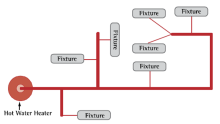
Sketch the general configuration for trunk and branch and for the core hot water delivery system types and explain the overall concept of each design and why the core system saves energy and water.
Problem Set
The fraction of solar radiation admitted through a window is characterized by? (a) Visible Transmittance (b) Solar heat gain coefficient (c) Light-to-solar gain (d) None of the above
Problem Set
True or False: It’s better to have a central air-conditioning system that's too large than to have a homeowner complain about being uncomfortable at the hottest time of year. a. True b. False
Teaching Material
This video describes how to calculate thermal conductivity and thermal resistance of building components.
Lecture Notes
These lecture notes provide basic information about the three modes of heat transfer.
Teaching Material
Trunk and branch: Large central pipe and smaller pipes to each fixture
Problem Set
Which of the following is NOT a type of HVAC System? Air Conditioning Furnace Heat Pump Domestic Hot Water Heater Fan
Lecture Notes
These lecture notes describe how to apply the laws of heat transfer to various types of insulation.
Problem Set
Circle all letters that apply to PEX (cross-formulated polyethylene): A. PEX is a soft plastic that comes in coils. B. PEX is remarkably durable within a wide range of temperatures, pressures, and chemicals. C. PEX is flexible. D. PEX stretches to accommodate the expansion of freezing water and then...
View the Contributors and Collaborators to learn about people and organizations that have helped create Building Science Education training material and those that have incorporated Building Science Education into their training and certification programs.